
Have Questions? Contact Us.
Since its inception, NYCLA has been at the forefront of most legal debates in the country. We have provided legal education for more than 40 years.
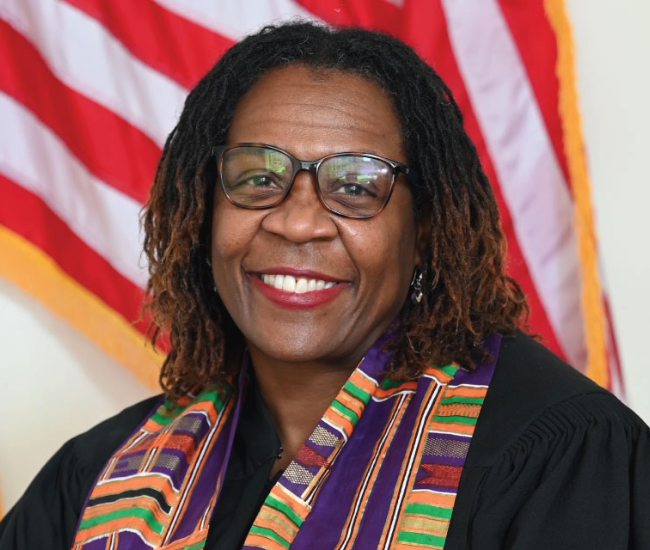
Welcome Remarks
Deputy Chief Administrative Judge Edwina G. Richardson
New York County Lawyers Association Committee on the Supreme Court
Reception Honoring the Judiciary
April 15, 2026
Good evening, everyone—and warm congratulations to tonight’s honorees. I am Edwina Richardson, Deputy Chief Administrative Judge for Justice Initiatives.
I have had the privilege of serving as a judge for more than twenty years, and for the past nine, as Deputy Chief Administrative Judge overseeing an office dedicated to ensuring that every person who enters a New York State courthouse experiences meaningful, equal access to justice.
Every day, I am grateful for the opportunity to serve the people of this state—and to support the extraordinary judges, court employees, and court officers who make up our Unified Court System.
It is a profound responsibility, and one I never take lightly.
Being a judge is an incredible job. But it is far more than a job—it is a calling. It carries a deep moral and ethical obligation:
• to each party who appears before you,
• to the rule of law,
• and to the communities we are so deeply privileged to serve.
Judges change lives. Judges shape communities. And judges lead—not only within the legal system but within the broader civic fabric of our state.
Justice Ruth Bader Ginsburg once reflected on her colleagues on the United States Supreme Court, saying: “Justices continue to think and change… I am ever hopeful that if the Court has a blind spot today, its eyes will be open tomorrow.” That hope—that imperative—belongs to each of us.
The question is: how do we shrink our blind spots?
First: think critically and creatively.
Yes, we are guided by precedent and charged with interpreting the law. But we do not decide cases simply because that is how they have always been decided. Even when facts seem familiar, we must pause and ask whether the outcome is just—and whether the law, as it has developed, still serves its purpose. Chief Judge Wilson wisely reminds us in his
introduction to the 2025 annual report that stare decisis, while important, is not an automatic endpoint. He called it “overrated”!
All who come before you deserve the fullest, fairest, most thoughtful consideration you can give.
Second: remain curious. Commit to being a lifelong learner.
Some of my richest learning moments have happened far outside traditional legal educational settings.
I recently completed the educational portion of a rigorous judicial coaching program—hours of coursework, online sessions, and now 100 hours of coaching before sitting for the certification exam.I met with Chief Judge Rowan Wilson to get him to talk me out of it, and he of course encouraged me to do it!
It has made me a better judge and more importantly, a better colleague.
Just this week, I found myself in Glen Ellen, California, learning about judicial leadership from a kidnapping survivor, an expert psychologist in high-conflict family matters—and yes—from horses. A program built around “Master Herder” leadership styles taught me lessons I will carry into the courtroom, into the workplace, and even into my interactions with family and friends.
Earlier today, I learned about justice and the rule of law from High School students who submitted artwork for the Law Day contest. Chief Judge Wilson will be announcing the winners on May 1st at the COA Law Day event!
Continuous learning is not academic—it is transformational.
Your curiosity and your openness to growth will help our courts continue to shrink their blind spots.
Third: remember our profound ethical responsibilities.
You are a judge not only when you are wearing the robe. You are a judge 24 hours a day, 365 days a year. That is a burden, yes. But it is also an honor and true privilege.
We are guided by the mission of the Unified Court System: to deliver equal justice under the law; to resolve matters fairly, justly, and timely; and to create a court system free from bias, discrimination, and disrespect.
And we are guided by the Rules of Judicial Conduct—especially Part 100.3, (Joe’s Rule) which reminds us to perform our duties impartially and diligently, to be patient and courteous, and to treat all who appear before us without bias or prejudice.
Finally: remember that you are not alone.
Talk with your colleagues. Learn from them. Share experiences. Just as the common law evolves collectively, so, too, does a judiciary.
When we rely on one another’s wisdom, we strengthen both ourselves and the institution we serve—and our communities are far better for it.
As you begin or continue your judicial service, I hope you will hold onto these touchstones:
• Think critically and creatively.
• Stay curious and committed to lifelong learning.
• Honor your moral and ethical responsibilities.
• And connect with your colleagues.
When we do these things, we embody the qualities Socrates attributed to every great judge: to hear courteously, to answer wisely, to consider soberly, and to decide impartially.
Justice Ginsburg reminds us that growth is possible—that our blind spots are not fixed.
Our courts can improve continuously, and each of us plays a vital role in making that promise real.
Congratulations once again to our honorees. And thank you for your service to the people of New York.